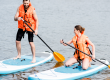
Paddle boating in a thunderstorm
All paddlers should prepare for the possibility of paddle boating in a thunderstorm. A pop-up thunderstorm can occur with little notice, so as a paddler, you need to plan for the potential of quickly changing conditions.
As part of your planning, familiarize yourself with the area you will be boating in by identifying potential safe havens and exit points along your route. Always have a plan for getting back to shore safely. Know where you can exit the water in case of an emergency.
If you’re caught in a storm, you should consider two principal threats:
- Open waters where the winds can whip up significant waves quickly as well as small rivers and creeks with effectively no fetch.
- The risk of lightning strikes.
What to do in open waters
The sea state could easily be far more hazardous than lightning. You need to consider headwinds, tailwinds, and crosswinds. As wind speed increases and becomes gusty, wave conditions become confused and not aligned with wind. Even so, you need to be aware of approaching waves, following waves and cross waves. Avoid being parallel to high waves. Instead, paddle at a 45-degree angle. This may mean zigzagging instead of paddling a straight line.
Stowing your paddle means that you have no control, and you will end up lying ahull to the waves, which could quickly lead to capsizing. It would be best to maintain steerage and head for the most easily reached sheltered area along shore. This probably means turning downwind in most conditions. Holding a kayak steady in following seas is tricky but doable. If upwind paddling is necessary, changing the offset of a kayak paddle’s blades is helpful. This means that the up direction of the two blades is different, possibly by as much as 60 degrees. All but the cheapest paddles are capable of this adjustment. Removing windage aloft by taking down fishing poles is a good idea. The number one priority is wearing a life jacket. Next, secure any loose gear.
If you are on a paddleboard, you need to get down to a kneeling position to keep better balance. If you do fall into the water, you will want to be wearing a high-quality leash. For other craft, keep your weight low and centered. Beach your craft in a sheltered area, such as the lee side of a point, not a shore being battered with waves. As you approach the shore, beware of boulders and fallen trees.
What to do with flash flooding
Where there aren’t going to be large waves developing, consider the dangers of flash flooding. The shore might be less safe than the river, especially if the banks are forested. One option is simply to head for the takeout point as quickly as possible. Another option is to find a safe place on shore to wait it out. Which one works depends on whether there are places to get off the water and whether they are safe.
Lightning safety strategies
Once on shore, find physical shelter in a building or automobile if you can. If not, seek a low-lying area away from tall trees, metal objects, and open fields. If you can’t find natural shelter, crouch down with your feet together, minimizing your contact with the ground to reduce the risk of a lightning strike. Do not lie flat on the ground.
If you can’t reach shore, position yourself low in the kayak to reduce your profile. If necessary, use your paddle to keep your craft upright in the wind and waves. Otherwise, stow your paddle and other metal objects including fishing rods. Paddles made with carbon fiber are also conductive.
Keep calm and try to ride out the storm. Do not lie down. You want the least amount of your body touching your watercraft as possible. If you have an extra life jacket or inflatable cushion, sit on that. If you are in a canoe, go down on your knees. Stow your gear so the vessel is properly trimmed. Keep your paddle in the water, as that provides stability if it is not conductive.
If you are with other boaters, separate the boats at least 50 to 100 feet apart so one strike will not affect a large group at the same time.
After the storm
Once the storm has passed, assess your situation. Check for any injuries, and ensure your craft and gear are intact. If needed, signal for help using your whistle or communication device.
Paddle boating is fun, but it’s important to be aware of your environment and prepare for all eventualities. –Lisa Shier, member of Huntsville Sail & Power Squadron and the Navigation Committee

Paddle Smart
Whether paddling on a calm lake or taking a rip-roaring adventure on white-water rapids, this America’s Boating Club seminar is the place to start.