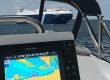
The importance of marine radar
If you have GPS on your boat, you might wonder, “Do I really need marine radar, too?” While marine radar and GPS both display the position of your boat on a screen of sorts, they serve different functions.
A GPS marine chart plotter shows you where you are located relative to marine chart data, such as shorelines and marker buoys. A marine radar display shows what it sees from your boat in real time, such as shorelines, boat traffic and other temporary obstacles.
The importance of both is obvious, so it’s not a question of “Do I need marine radar?” but rather “Is marine radar a practical navigation device for the type of boating that I do?” When you see the quality of today’s lower-cost products, you will most likely answer “yes.”
How marine radar works
Standard marine radar operates by shooting rapid microwave pulses of energy. By rotating as it shoots, it provides a 360-degree picture. Solid objects are identified and positioned on a screen based upon how much time it takes the pulses to be reflected. Newer broadband radars transmit continuous waves with increased frequency moving away from the dome. When the waves hit a target, they reflect to the receiver. The difference between frequency in the transmitted and returned waves determines target distance.
Because the Earth’s surface is curved and radar waves travel in a straight line, the height of a radar antenna and the height of the target determines how far your radar can see. For this reason, a good antenna height is important.
The unit’s power determines its range. For example, a 2-kilowatt radar can paint objects 20 miles away, while a 4-kilowatt unit can reach objects 32 miles away. Such distances are usually sufficient for most recreational boating activities.
The width of radar wave beams is generally between 1 degree for the more powerful units and 6 degrees for the more economical ones. As you would expect, narrower beams with a more focused pulse provide better target differentiation.
Helpful features to look for include the ability to mark target boats and show their direction and speed. In addition to the standard features such as alarms and distance settings, most radars today incorporate advanced software that allows you to set your radar to a full-auto mode, eliminating the need for constant tuning and adjustments. The improved sensitivity on these new systems clearly identifies floating objects and small buoys. Another important development is the lower power requirement; newer radar systems draw less power than a cell phone.
Reading marine radar
Even with current models, you may find the depictions on your screen difficult to interpret at first. I recommend taking a United States Power Squadrons, America’s Boating Club, course on the subject. Once on the water, turn on your radar during day trips and compare what’s on the screen with what you see ahead. This is an excellent way to learn how to interpret the screen and become proficient with your radar.
With today’s efficient and affordable selection of marine radar units for recreational boaters, we should start seeing more radar antennae on runabouts and center consoles. If you would like to boat more at night, travel to new destinations, or just add safety to your cruising, now is the time to look for a marine radar system that matches your boating needs. –Bill Jennings
This article was originally published on BoatBlurb.com.

Radar for boaters
Learn the different types of radar equipment, their capabilities and limitations, as well as their features and how they apply to boaters’ needs.