Marine VHF radios to display four-digit numbers
To improve effectiveness in the use of the VHF maritime band, new Marine VHF radios will display four-digit channel numbers. This change reflects harmonized US and ITU channel standards and differs from the current two-digit assignments US recreational boaters are used to.
Some background
In the late 1980s, a cargo ship from overseas with a pilot onboard, transiting Long Island Sound, was unaware that a gasoline barge had gotten loose in the area at the time the ship was underway. The U.S. Coast Guard had made an urgent marine information broadcast, but neither the pilot nor ship’s master knew anything of it until the ship arrived safely into port. The annoyed pilot made his displeasure known to his Congressional representative. The Coast Guard had broadcast its warning about the loose gasoline barge on VHF channel 22A, as all such UMIBs are still made today.
Congress was then drafting what became the Oil Pollution Act of 1990, and consequential to this loose gasoline barge incident, the Coast Guard updated its Bridge-to-Bridge Radiotelephone Regulations in 33 CFR 26(a)(d) to state “The radiotelephone required by (this regulation) must be capable of transmitting and receiving on VHF FM channel 22A (157.1 MHz).”
How marine VHF radios operate
So, why were the pilot and master unable to hear the Coast Guard UMIB regarding the loose gasoline barge? What is the meaning of the letter “A” in the channel number?
Marine VHF radios are transceivers: They contain both a transmitter and a receiver. These radios work within a band from 156 MHz to 162 MHz that has been divided into many specific frequencies. Most people don’t think about it, but there is no rule in physics or electronics that the same frequency must be used for both transmission and reception. Engineers learned to take advantage of this many years ago. The terms to describe these modes are simplex and duplex operation.
In simplex operation, both the coast and ship stations transmit and receive on one frequency. This can be thought of as “party line” operation in which everyone is talking on the same line, possibly at the same time. In duplex operation, coast and ship stations operate on different frequencies, eliminating the party line effect. Duplex allows for more efficient operation, but the use of simplex channels assures reception by any vessel within range.
The first maritime VHF channeling plan consisting of Channels 1 to 28 was adopted at the International Telecommunications Union World Administrative Radio Conference held in Geneva, Switzerland, in 1959. In 1965, the Federal Communications Commission issued final rules implementing this 1959 WARC decision.
Most of the international maritime spectrum unavailable for use in the US came from the upper frequency bands, above 160 MHz. These frequencies had been designated by WARC 59 as the coast station transmit portion of duplex channels 1 through 5, 7, and 18 through 28. Channel 20 and the public correspondence channels 24 through 28 were adopted in the US as ITU had intended them. The remaining duplex channels 1, 5, 7, 18, 19, 21, 22 and 23 were made simplex in the US, allowing both ship and coast stations to transmit on the same ship station transmit frequency from the 156–157 MHz band. Channel 20 could be used either as simplex or as duplex. The US standards thus diverged from those of the ITU.
Radios operating on a duplex channel cannot communicate with a radio operating simplex on that channel. Since both schemes use the same channel numbering, the FCC added the suffix “A” to designate simplex use over the ship station transmit portion of the international duplex channel, to avoid confusion. A shipboard radio tuned to channel 22 (international mode) transmits on 157.1 MHz and listens on 161.7 MHz. A shipboard radio tuned to channel 22A (US mode) both transmits and listens on 157.1 MHz. That was the reason the pilot and master could not hear the loose gasoline barge UMIB in Long Island Sound. The ship’s radio could only tune to channel 22 and could not tune to channel 22A. They had no way of listening on the 157.1 MHz frequency.
Updates to marine VHF radios
So, why are new marine VHF radios now displaying four-digit channel numbers?
For 50 years, the US VHF maritime channeling plan differed from that of the rest of the world, as specified by the International Telecommunications Union. The “A” channel number shows that difference. When synthesized transmitters replaced crystals in later radios, manufacturers added a US/International switch to allow users to communicate both within and outside US waters. Today, that switch is now a menu selection, and the option to select Canadian channels has also been added.
Over time, the same need for flexibility that caused the US to deviate from the ITU VHF channeling plan affected the rest of the world, too. The World Radiocommunication Conference held in Geneva in November 2015 rewrote the table of transmitting frequencies in the VHF maritime mobile band, making allowances for administrations to make simplex use of duplex channels, just as the US had done 50 years earlier.
Here is the issue: ITU chose not to recognize FCC’s scheme of identifying simplex use of duplex channels with the letter “A” or “B” (“A” indicates simplex use of the ship station transmit pair of a duplex channel. “B” indicates simplex use of the coast station transmit pair of a duplex channel; “B” channels are not used in the US but are used in Canada).
Not all channels have four digits. Just as the US channel designator “A” is only used as a suffix to designate simplex use over the ship station transmit portion of the international duplex channel, the designator “10” is only used as a prefix for this same purpose.
ICOM, Standard Horizon, and Garmin VHF radios displayed at the 2024 National Marine Electronics Association Conference in Providence, Rhode Island, all showed four-digit channel numbers as the default, and the International Maritime Organization is requiring VHF radios used on SOLAS ships to be updated with this new channel designation following the first radio survey after Jan. 1, 2028.
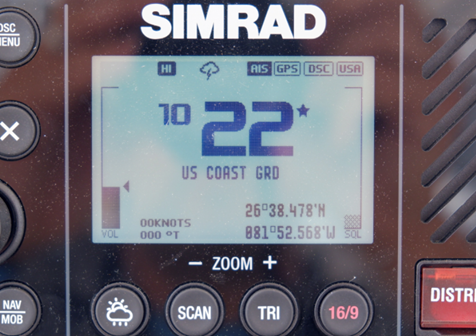
Channel 1022 (old Channel 22A). Courtesy Simrad
Impact on recreational boaters
As stated above, radio manufacturers are now producing VHF transceivers with the four-digit numbering scheme installed. There is no operational impact to the changes in channel numbering. All two-digit assignments remain the same, all designated uses remain the same, and all frequencies remain the same. The only real change is the use of the four-digit designation instead of the “A” designation in use today.
Four-digit channel designations are listed in this table.
ITU had studied other ways to improve efficiency in the use of the VHF maritime band, including migration to narrow-band channels, interleaved narrowband channels at 12.5 kHz, assignment of channel numbers to interleaved channels, and assignment of channel numbers to simplex operation over duplex channels. That study is documented in Recommendation ITU-R M.1084-5, Interim solutions for improved efficiency in the use of the band 156–174 MHz by stations in the maritime mobile service.
Stay tuned in the coming years—significant changes are coming to improve the flexibility, functionality, and utility of the marine VHF band.
RTCM has been working with the Coast Guard and U.S. Coast Guard Auxiliary, FCC, IMO, radio manufacturers, America’s Boating Club | United States Power Squadrons, NMEA and others to ensure familiarity with these new channel designators, and to ensure that mariners never again miss a Coast Guard UMIB broadcast such as the missed warning of a loose gasoline barge that occurred in Long Island Sound some 35 years ago. –Gene Danko
This article was adapted from a manuscript created for Marine Electronics Journal, courtesy Joe Hersey and the Radio Technical Commission for Maritime Services

Stay connected
Do you know how to use your VHF? Discover the different types of marine radios as well as how to use them with our online seminar, All About Marine Radio.