
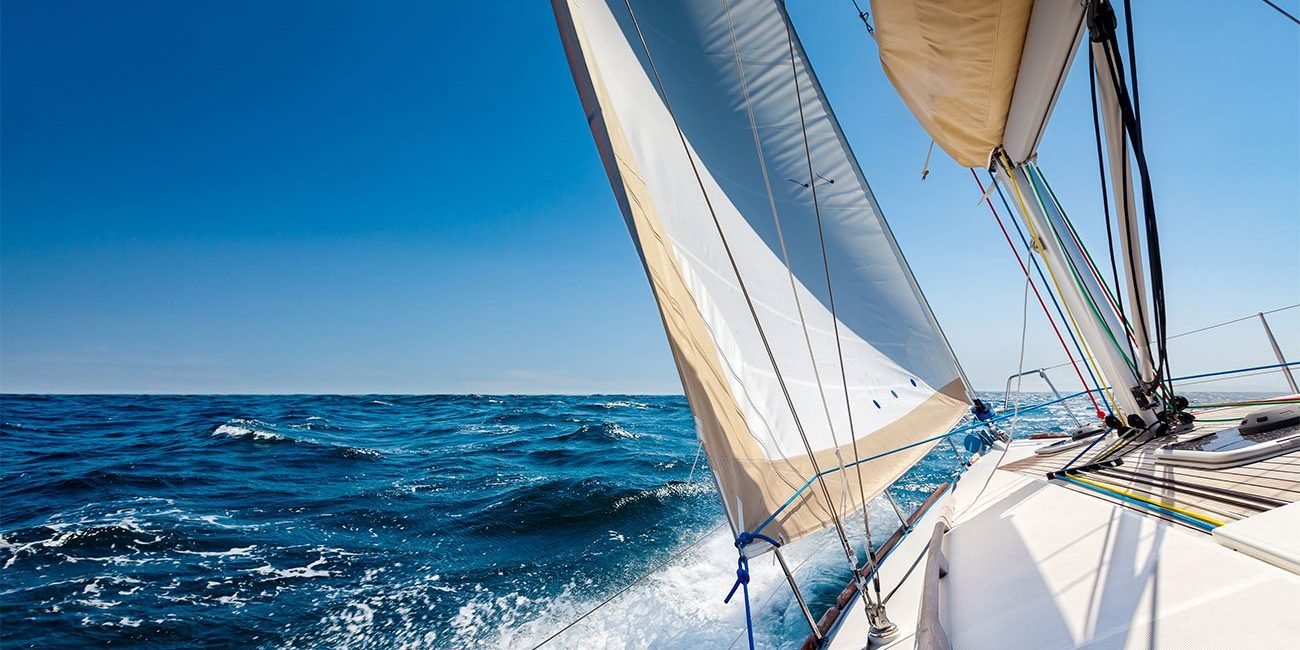
Preparing to sail
There’s a lot to do when preparing to sail, such as stepping the mast, bending-on and hoisting the sails, and getting under way skillfully and quickly.
Stepping the mast
Once launched, most large sailboats stay in the water for extended periods. For these boats, stepping the mast is an infrequent occurrence. Boats not left in the water may have their masts stepped and removed frequently. Crew weight on the foredeck may damage lightweight racing boats if the mast is stepped with the boat on its trailer and cradle. If a boat on a trailer is moved with the mast up, be sure to check for overhead power lines.
When stepping the mast on a small centerboard boat in the water, take care not to capsize the boat. Boats are less stable with added weight near the bow. Board the boat abaft the beam. Step in toward the center of the boat, not on the gunwale. If the water is deep enough, lower the centerboard. Stay aft of the mast and straddle the centerline when possible. Install the rudder and tiller before raising the sails.
Bending-on the mainsail
The mast and boom of most sailboats have grooves called coves that will fit a bolt rope or slugs, small cylinders attached to the foot or luff of the sail. When bending-on the mainsail, slide the bolt rope or the slugs into the slot in the boom at the tack end, i.e., near the mast. Pull the clew aft, working the entire foot of the sail into the slot. Attach the clew to the overhaul and the tack to the gooseneck. Apply some tension on the foot with the outhaul. Final foot tension adjustments will be made when you hoist the sail. Some masts and booms, especially those on cruising boats, have tracks instead of coves. Sail slides fit onto the track. Using slugs or slides enables cruising boat skippers to lower the mainsail (leaving it connected to the mast) and flake it, accordion-style, on the boom for storage rather than removing it after each day’s sail.
Install the battens in the bottom pockets. Before connecting the luff of the sail to the mast, run a hand along the entire luff to ensure it’s not twisted. With slugs or slides on a cove of the mast, install them one at a time, working down from the head of the sail. When they are all entered, engage the stop in the cove that keeps them from falling out. Do not hoist the sail until ready to cast off. On windy days, with the sails raised and the boat on the mooring, flogging sails can become damaged. Additionally, the boom whipping back and forth can cause injuries. When ready to hoist, make sure that the mainsheet is released and that the boom is not constrained from rising. Check that the main halyard is not fouled on the rigging, and connect it securely to the head of the mainsail. If the mast has a cove for a bolt rope rather than a track, insert the bolt rope at the head of the sail into the cove. Then, hoist the mainsail while continuously aligning the sail with the cove at the entry to avoid jams.
Bending-on the jib
When bending-on a headsail, first attach the tack cringle to the tack fitting. If the sail was properly bagged, the tack cringle should be the first part to emerge from the sail bag.
On small boats, the jib is often attached to the jib-stay or headstay with plastic snap hooks or cloth tabs with metal snaps. On larger boats with roller furling, use aluminum rods or tubes with one or more slots to accommodate a jib bolt rope. Connect jib hanks or snaps to the stay working from the tack to the head. Straddle the sail to trap the sail between your legs to keep the clew from going into the water. Run a hand along the luff as the hanks or snaps are attached to make sure that each is securely and correctly engaged.
When reaching the head of the sail, securely attach the jib halyard to the head cringle, making sure the jib halyard is not fouled. Then, attach the jib sheets to the clew cringle. On large boats, use bow lines tied close to the clew. Avoid using metal shackles and blocks to attach sheets to jib clews as metal fittings on flapping jib clews can cause injury. It may be advisable to avoid hoisting the jib until underway and to douse the jib before entering a crowded mooring area.
After bending-on sails on boats with engines, consider motoring out to open water before hoisting sail. Hoist the mainsail first and then the jib. It is best to hoist the sails with the boat headed into the wind.
Folding the sails
Before bagging the sails, fold them so the creases are parallel to the direction of airflow over them when in use. Creases at an angle to the airflow over them may cause the flow to detach from the sail at the crease line. If rolling your sails instead, roll them from head to foot, perpendicular to the leech, and leave the battens in the pockets.
On boats with jib roller furling, store the rigged jib rolled up on the headstay. Before leaving the moored boat after sailing, tie a line around the roller furled jib to prevent it from unfurling if a storm comes along. Flake the mainsail on the boom, tie it down, and protect it from ultraviolet radiation with a sail cover. In the off season, sails should be washed with a mild, neutral soap and soft bristle brush, inspected, and repaired. Sails must be dried before storing. Choose a relatively calm day so that the drying can be accomplished by flying the sails from the masthead using a halyard. In humid climates, take precautions to store the sails in a dry, well-ventilated place to protect against mildew.

Feel at home on the water
Learn to boat with confidence by taking the Boat Handling course online from America’s Boating Club.


Many good pointers.
However, be consistent and avoid auto-correct typos!
If you refer to the “groove” on a spar as its “cove”, then why refer to it as “slot” in the very next sentence?
At 4th sentence “attach the clew to the outhaul…”, NOT overhaul.
Boat nomenclature is challenging enough without such above distractions.